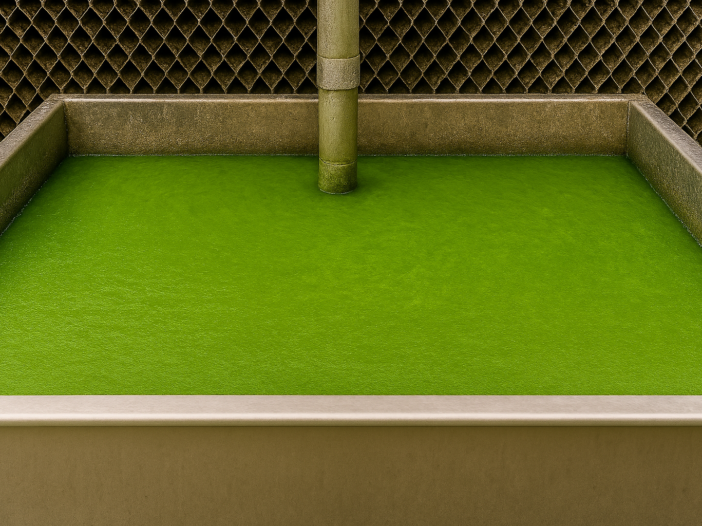
Biofilm—the slime-like layer of microorganisms and extracellular polymers that coats cooling surfaces—is one of the most damaging yet often underestimated threats to industrial cooling tower efficiency. Unlike mineral scale or corrosion products, biofilm’s exceptional insulating properties make it uniquely destructive to heat transfer performance and equipment reliability. Glacier Labs specializes in diagnosing and controlling biofilm before it erodes your operational margins and energy budget.
What Biofilm Is and How It Forms
Biofilm consists of bacteria, algae, and fungi embedded in a self-produced matrix of extracellular polysaccharides (EPS). This sticky biopolymer matrix holds the microbial community together and protects it from chemical attack—including biocides—making biofilm far more resilient than planktonic (free-floating) microorganisms.
Biofilm forms readily in cooling towers because the environment is ideal: warm water (typically 25–45 °C), constant aeration, abundant nutrients from makeup water and process carryover, and wetted surfaces for microbial attachment. Once bacteria adhere to a heat exchange surface, they proliferate rapidly and build protective matrix material. What begins as a microscopic film within days can become a thick, slimy coating that degrades performance and drives up operational costs.
The Thermal Insulation Problem
The most consequential impact of biofilm is its devastating effect on heat transfer efficiency. Biofilm is over 90% water by weight, giving it thermal properties similar to stagnant water—making it an exceptional insulator.
Consider the numbers:
- A biofilm layer of just 100 microns (0.1 mm) on a copper heat exchanger tube can reduce heat transfer by 98%.
- A 20 micron biofilm—barely visible—increases heat transfer resistance by 7%.
- A 1 mm biofilm accumulation on low-carbon steel has thermal resistance equivalent to an 80 mm increase in tube wall thickness.
In practical terms: once biofilm begins to accumulate, cooling capacity drops sharply. Your chiller outlet temperatures rise. Your cooling tower fan runs harder and longer. Your refrigeration or process systems struggle to maintain setpoint, consuming 20–30% more energy to achieve the same cooling duty.
Beyond Heat Transfer: Corrosion and Operational Problems
Biofilm’s damage extends well beyond insulation effects:
- Microbiologically influenced corrosion (MIC)
Bacteria beneath the biofilm consume oxygen faster than it can diffuse from bulk water, creating anaerobic micro-environments at the metal surface. This oxygen gradient drives galvanic-like corrosion, accelerating pitting and metal loss, particularly in carbon steel and admiralty brass tubes.
- Increased pressure drop and flow obstruction
Thick biofilm deposits narrow flow paths, reduce effective heat transfer area, and force higher pumping power. Strainers foul more frequently; maintenance visits increase.
- Persistent re-fouling
Once a surface is colonized and cleaned, residual biofilm fragments act as “seed” sites for rapid recolonization. Previously fouled surfaces re-foul far more quickly than virgin surfaces, creating a vicious cycle.
- System reliability
Uncontrolled biofilm forces unplanned cleanings, production delays, and extended maintenance shutdowns.
Recognition and Early Detection
Proactive monitoring catches biofilm before it becomes a crisis. Key indicators include:
- Visible slime or brown/black films on tower fill, tubes, and baffles.
- Rising condenser or heat exchanger outlet temperatures without a corresponding increase in cooling load.
- Elevated differential pressure across heat exchangers.
- Odors or discoloration in cooling water that worsen over days or weeks.
- Recurrent cleaning requirements shorter than historical pattern.
Laboratory analysis—including biofilm sampling, planktonic bacterial counts, and metabolic activity assays—provides quantitative confirmation and guides treatment strategy.
Effective Biofilm Control
Biofilm control requires a multi-layered approach. No single tactic is sufficient:
- Biocides and dispersants
Oxidizing biocides (chlorine, bromine) and non-oxidizing biocides target planktonic bacteria. Dispersant polymers break apart biofilm matrix, exposing embedded cells to biocide action. Timing and dosage must be optimized; protective matrix material can shield biofilm cores from chemical treatment.
- Filtration and particulate control
Removing suspended solids and organic debris reduces nutrient load and slows microbial proliferation. Side-stream filtration (10–50 micron) is particularly effective.
- System design and maintenance
Minimizing dead legs, dead zones, and stagnant areas where biofilm thrives. Ensuring proper blowdown and drift elimination to manage nutrient concentration. Regular mechanical cleaning of tower surfaces and tubes.
- Water chemistry optimization
Low-calcium makeup water and controlled pH can suppress biofilm formation. Corrosion inhibitor films also discourage microbial adhesion.
- Real-time monitoring
Continuous online sensors for biofilm thickness or microbial metabolic activity provide early warning before performance loss becomes acute.
Why Glacier Labs Approach Works
At Glacier Labs, we integrate biofilm control into a comprehensive cooling water management program. We don’t treat biofilm as an isolated problem:
- We assess your system’s susceptibility based on water source, temperature profile, design, and process streams.
- We establish baseline microbial activity and biofilm presence using proven sampling methods.
- We design a chemical and operational control strategy—tailored to your metallurgy, discharge requirements, and production constraints.
- We monitor continuously and adjust dosing and dispersant selection based on real performance data.
The result: cooling towers that stay clean, efficient, and reliable. Heat transfer remains near design capacity. Energy costs stay predictable. Corrosion is minimized. Unplanned maintenance is avoided.
Biofilm doesn’t have to be inevitable. With expert monitoring and a disciplined treatment program, your cooling system can stay protected.
References
[1] Solenis. (n.d.). Solving the biofilm threat in industrial cooling water systems. Solenis Technical Document.
[2] AMSA Inc. (2024). Understanding the negative impacts of biofilm on heat exchange. Retrieved from https://amsainc.com/learning-center/understanding-the-negative-impacts-of-biofilm-on-heat-exchange/
[3] Tower Water. (2025). Biofilm prevention & corrosion control for cooling towers. Retrieved from https://towerwater.com/biofilm-prevention-corrosion-control-for-cooling-towers/
[4] Cooling Tower Water. (2025). Biological fouling control in cooling tower circulating water systems. Retrieved from https://www.hmcoolingtower.com/blog/biological-fouling-control-in-cooling-tower-circulating-water-systems/
[5] Chemical Engineering. (2020). Caring for cooling water systems. Chemical Engineering.
[6] NCBI/NIH. (2023). Biofilms controlling in industrial cooling water systems: A mini-review of strategies and best practices. PubMed Central, 37(8).
[7] Water Technologies. (2004). Chapter 26—Microbiological control in cooling systems. Water Treatment Handbook.
[8] NCBI/NIH. (2021). Assessment of the impact of temperature on biofilm composition and heat transfer resistance. PubMed Central, 8(5).
[9] Aquarius Technologies. (n.d.). Biofilm effects on heat transfer of heat exchangers. Retrieved from https://aquariustech.com.au/
[10] Veolia Water Technologies. (2022). Microbiological control strategy in cooling tower systems. Retrieved from https://www.veoliawatertech.com/
Biofilm—the slime-like layer of microorganisms and extracellular polymers that coats cooling surfaces—is one of the most damaging yet often underestimated threats to industrial cooling tower efficiency. Unlike mineral scale or corrosion products, biofilm’s exceptional insulating properties make it uniquely destructive to heat transfer performance and equipment reliability. Glacier Labs specializes in diagnosing and controlling biofilm before it erodes your operational margins and energy budget.