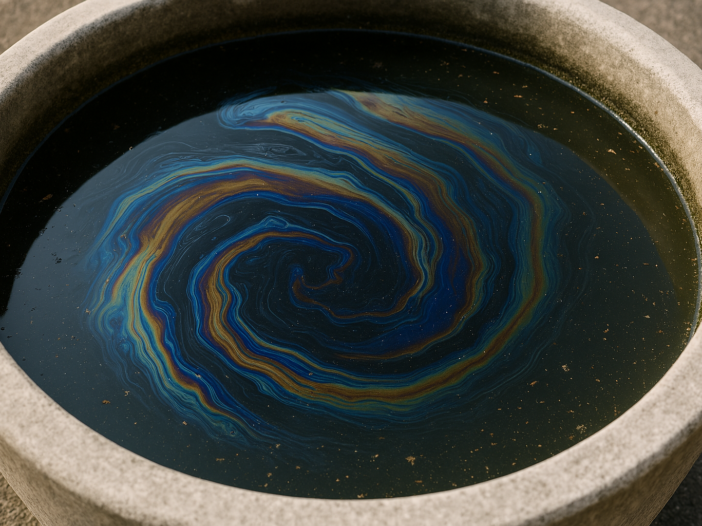
Oil and hydrocarbon contamination in cooling water is one of the most under‑diagnosed problems in industrial water systems. While operators quickly address scale, corrosion, or biological fouling, oil often enters quietly—through a leaking exchanger, a failed seal, or poor housekeeping—and then drives a cascade of reliability and compliance issues.
This guide summarizes how oil gets into cooling water systems, why it matters, how to identify it early, and the practical tools and treatment strategies available to remove it and keep it from coming back.
Why Oil in Cooling Water Matters
Even low concentrations of oil or hydrocarbons in recirculating cooling water can have outsized consequences:
- Reduced heat transfer efficiency
- Oil forms a low‑conductivity film on heat transfer surfaces, similar to scale or biofilm.
- Cooling towers, condensers, and exchangers operate at higher temperatures and use more energy to achieve the same cooling duty.
- Increased fouling and microbiological problems
- Oil provides a carbon‑rich food source for bacteria and fungi, promoting biofouling in towers and basins.
- Mixed oil, solids, and biomass can form tenacious deposits that are difficult to remove and exacerbate under‑deposit corrosion.
- Corrosion and equipment damage
- Oil and associated contaminants can trap oxygen and corrosive species at metal surfaces.
- Emulsified oils and additives from process streams can alter water chemistry and accelerate under‑deposit corrosion, particularly in carbon steel systems.
- Operational and maintenance impacts
- Dirty systems require more frequent cleanings, unplanned shutdowns, and increased labor.
- Mechanical components—pumps, spray nozzles, strainers—plug or foul more quickly.
- Environmental and regulatory risk
- Cooling tower blowdown and other discharges containing oil and grease are subject to regulatory limits.
- Visible oil sheens or exceedance of oil & grease limits in effluent can lead to fines and reputational damage.
- Safety and housekeeping
- Oil accumulation on walkways, tower decks, or access areas creates slip hazards.
- Mist and odors from oily water can degrade working conditions, especially in enclosed or semi‑enclosed spaces.
For industrial sites where cooling systems are central to production—refineries, chemical plants, power generation, metal processing, food manufacturing—oil in cooling water is not just a water treatment issue; it is a production and reliability risk.
How Oil Enters Cooling Water Systems
Oil contamination is typically a symptom of upstream mechanical or process issues. Common pathways include:
- Heat exchanger and condenser leaks
- Process side hydrocarbon leaks across tube bundles into cooling water.
- Typical in refineries, petrochemical plants, and power plants handling lubricating oils, fuels, or process solvents.
- Hydraulic and lubricant leaks
- Failure of shaft seals, packing, or mechanical seals on pumps and rotating equipment.
- Leaks from gearboxes, bearings, or hydraulic units located above or near open cooling basins or tower decks.
- Compressor and chiller oil carryover
- Oil from refrigeration compressors or chillers that use oil‑lubricated systems can carry over into cooling circuits if separators or demisters fail.
- Poor housekeeping and drainage
- Wash‑downs of oily floors or equipment areas routed directly or indirectly into cooling basins.
- Stormwater runoff picking up oil from paved or process areas and entering cooling water makeup or return streams.
- Cross‑contamination with other wastewater
- Mis‑routed process drains or sump discharges that contain oil being sent to cooling tower basins or return lines as a convenience.
Understanding which of these pathways is most likely in your facility is critical; oil removal technology will not solve a persistent leak if the underlying mechanical problem is left unaddressed.
Types and Forms of Oil Contamination
Oil contamination in cooling water is not uniform. Its behavior—and how difficult it is to remove—depends on how it exists in the water phase.
- Free (separated) oil
- Visible slicks or droplets floating on the surface.
- Typically from gross leaks or spills.
- Relatively easy to remove by skimming, decanting, or physical separation.
- Dispersed (suspended) oil
- Small droplets distributed through the water column, may appear as turbidity or a “milky” haze.
- Often generated by mechanical agitation (pumps, turbulence) which breaks oil into droplets.
- Emulsified oil
- Droplets so fine and stabilized by surfactants, corrosion inhibitors, or natural organics that they stay suspended and do not coalesce.
- Water appears cloudy, sometimes with a stable “cream” layer.
- Requires chemical destabilization (e.g., pH adjustment, coagulants, demulsifiers) before physical separation is effective.
- Dissolved hydrocarbons
- Certain low‑molecular‑weight components can dissolve into water.
- Often only detected via analytical methods, not visually.
- May require advanced treatment (e.g., activated carbon, advanced oxidation) if present at problematic levels.
A credible treatment program must first identify which forms of oil are present; a simple belt skimmer that works well on free oil may do little or nothing for stable emulsions.

How to Recognize Oil in Cooling Water
Early detection can prevent small leaks from becoming system‑wide problems. Consider a tiered approach combining field observation, simple screening tests, and instrumentation.
1. Field Observations and Simple Checks
- Visual inspection
- Look for:
- Rainbow sheens or discrete oil patches on tower basins, sumps, and separators.
- Unusual “cream” or foam layers on the water surface.
- Oil staining on tower deck, drift eliminators, and structural components.
- Odor
- Hydrocarbon odors, burnt oil smells, or unusual organic odors compared to baseline operation.
- Operational symptoms
- Progressive loss of cooling performance at roughly constant load.
- Increase in heat exchanger approach temperatures beyond what scaling alone would explain.
- Increased differential pressure across strainers, filters, or exchangers due to fouling.
2. Basic Testing and Laboratory Support
- Oil & Grease testing (e.g., hexane extractable material)
- Quantifies oil & grease levels in ppm for compliance and trending.
- Suspended solids and turbidity
- Elevated levels may indicate dispersed oil plus solids, especially when combined with visual “milkiness.”
- Microscopic examination
- A simple microscope or imaging tool can often differentiate droplets of oil from biological floc or mineral particles.
- Root‑cause analysis
- When oil is found, correlate timing with:
- Maintenance events.
- Process upsets.
- Changes in source water or streams tied into the cooling system.
3. Online Monitoring
For higher‑risk systems, online monitoring can provide real‑time protection:
- Oil‑in‑water monitors
- Optical or fluorescence‑based instruments that detect free oil and suspended solids in cooling water.
- Provide alarms or automatic shutdown signals when contamination exceeds a set threshold.
- Integrated sensor packages
- Combine oil detection with conductivity, turbidity, pH, and temperature for more complete diagnostic capability.
Consequences Illustrated: Practical Examples
Example 1 – Refinery Cooling Tower with Heat Exchanger Leak
A refinery’s recirculating cooling system began to show:
- Rising tower outlet temperatures.
- Heavy organic fouling on exchanger tubes.
- Occasional visible sheens in the tower basin.
Investigation revealed a small hydrocarbon leak across a shell‑and‑tube exchanger. Oil entering the cooling water caused:
- A thin insulating film on heat transfer surfaces.
- Biofouling accelerated by oil as a nutrient source.
- An increase in tower fan energy and pumping costs to maintain product temperatures.
Once the leak was located and the exchanger repaired, the refinery:
- Implemented oil‑in‑water monitoring on the exchanger outlet.
- Added a surface oil skimmer and surge tank to intercept any future leakage.
- Strengthened its chemical program to manage residual organic load.
Example 2 – Manufacturing Plant with Hydraulic Leaks Near Tower
A plastics plant had hydraulic power units located on a mezzanine above the cooling tower deck. Small but chronic hydraulic leaks dripped onto the deck, then washed into the tower water during cleaning and rain events.
Consequences included:
- Persistent oil slicks in the basin.
- Plugging of strainers with oily debris.
- Complaints of odor and mist.
Mitigation involved:
- Repairing and relocating the most leak‑prone equipment away from open water surfaces.
- Installing a belt oil skimmer on the basin.
- Implementing a stricter housekeeping and spill‑response procedure.
The result was improved tower cleanliness, less maintenance on strainers and pumps, and better working conditions near the tower.
Treatment Options: Removing Oil from Cooling Water
Selection of oil removal technology depends on:
- The form of oil (free vs emulsified).
- The volume and concentration of contamination.
- System layout and hydraulics.
- Regulatory and discharge requirements.
Below is a practical overview of commonly used approaches.
1. Source Control (Always Step One)
Before investing in treatment hardware, identify and eliminate or minimize the source:
- Repair leaking heat exchangers, condensers, and coolers.
- Replace or repair faulty mechanical seals and gasketed joints.
- Improve containment and drainage in oily areas:
- Curbing or berms.
- Separate oily sewer vs clean cooling drains.
- Enhance operating procedures:
- Prohibit discharge of oily wash water into tower basins.
- Implement preventive maintenance to detect leaks early.
2. Physical Separation for Free Oil
Best suited where oil is primarily free and not heavily emulsified.
- Gravity separators and API‑style oil‑water separators
- Use differences in density to separate oil from water.
- Often used on blowdown, sump, or side‑stream loops.
- Require sufficient residence time and proper flow control.
- Coalescing plate separators
- Corrugated plates provide surface area where small droplets can coalesce into larger, faster‑separating droplets.
- Improve separation efficiency for dispersed oil compared to simple tanks.
- Skimmers (belt, tube, or disk)
- Device‑mounted belts or tubes attract oil preferentially and wipe it into a collection trough.[5]
- Advantages:
- Low maintenance.
- No consumable filter media.
- Effective for free oil and light slicks in basins or sumps.
- Limitations:
- Ineffective on stable emulsions.
- Require suitable access and positioning.
3. Chemical Conditioning plus Physical Separation
When oil is emulsified or exists as fine droplets, chemistry is often required to destabilize the emulsion and enable separation.
Typical approaches include:
- pH adjustment
- Lowering the pH (often with sulfuric acid) can destabilize emulsified oils, especially where natural or added surfactants are present.
- Once destabilized, oil droplets coalesce and rise to the surface, where they can be skimmed.
- Coagulants and flocculants
- Inorganic coagulants (e.g., iron or aluminum salts) and organic polymers can bridge particles and droplets into larger floc.
- Floc can then be removed via clarification, flotation, or filtration.
- Specialty demulsifiers
- Formulated chemistries designed to break specific emulsions or oil types.
- Often used in refinery, petrochemical, and metalworking streams where conventional coagulants are insufficient.
These methods are commonly deployed in:
- Side‑stream treatment loops for cooling tower basins.
- Central wastewater treatment where cooling blowdown is a significant portion of the oily load.
4. Advanced and Polishing Technologies
For challenging applications or where strict discharge limits apply, additional technologies may be used:
- Dissolved air flotation (DAF)
- Fine air bubbles attach to suspended solids and oil droplets, carrying them to the surface where they are skimmed.
- Often paired with coagulation and flocculation.
- Media and membrane filtration
- Sand, multimedia, or specialty media filters capture oil‑bearing floc and solids.
- In some cases, ultrafiltration membranes can remove emulsified oils, though fouling must be managed carefully.
- Adsorption (e.g., activated carbon)
- Targets dissolved organics or low‑level residual hydrocarbons.
- Specialty oil removal units
- Systems combining separation, coalescence, and filtration, designed for high‑duty industrial wastewater.
Integrating Oil Control into a Cooling Water Program
Addressing oil in cooling water is most effective when integrated into your overall water treatment and reliability program rather than treated as a one‑off incident.
Key elements include:
- Baseline risk assessment
- Map equipment that contains oil or hydrocarbons and interfaces with cooling water (exchangers, compressors, seals, nearby process areas).
- Identify which leaks would likely discharge directly or indirectly to the cooling system.
- Monitoring and trending
- Establish routine inspection and sampling locations:
- Cooling tower basin.
- Critical exchanger outlets.
- Sumps and low points.
- Trend:
- Oil & grease concentrations.
- Heat exchanger performance (approach temperature).
- Differential pressure across exchangers and filters.
- Trigger limits and response plans
- Define what oil levels or visual observations trigger:
- Operating changes (e.g., bypassing a leaking exchanger).
- Deployment or adjustment of skimmers and separators.
- Engagement of maintenance to locate and repair leaks.
- Coordination between operations, maintenance, and water treatment
- Share data across disciplines so that:
- Water treatment teams alert maintenance to suspected leaks.
- Maintenance informs water treatment when equipment repairs or changes could affect oil ingress.
- Documentation and training
- Develop procedures for:
- Spill response and containment.
- Safe handling and disposal of recovered oil.
- Regular inspection and cleaning of oil removal equipment.
Practical Steps if You Suspect Oil in Your Cooling Water
If your facility is seeing unexplained fouling, performance loss, or visible sheens, a structured response can prevent a minor issue from escalating:
- Confirm the presence of oil
- Conduct visual checks, basic field tests, and lab oil & grease testing.
- Compare to historical baseline data where available.
- Isolate likely sources
- Evaluate recent maintenance and process changes.
- Check exchangers and condensers handling oily streams.
- Inspect areas where lubricants or hydraulic fluids may reach open water.
- Implement temporary controls
- Deploy portable skimmers or temporary separation tanks where feasible.
- Adjust blowdown and side‑stream treatment rates to maintain water quality.
- Plan and execute permanent mitigation
- Repair or replace leaking equipment.
- Integrate permanent oil removal technologies (skimming, coalescing separation, side‑stream treatment) sized to your system.
- Optimize your chemical program to handle residual organic load and prevent under‑deposit corrosion and biofouling.
- Review and update your program
- After remediation, review:
- What monitoring signals were missed earlier.
- How quickly the organization responded.
- Update procedures and training to shorten response time in future events.
How Glacier Labs Can Help
Glacier Labs specializes in industrial water treatment programs where cooling reliability, environmental compliance, and total cost of ownership are all critical.
When dealing with oil in cooling water, we typically:
- Assess your system holistically
- Cooling water chemistry.
- Heat exchanger configurations and duty.
- Upstream process and mechanical sources of oil.
- Existing oil and solids handling infrastructure.
- Characterize the contamination
- Distinguish free, dispersed, and emulsified oil.
- Evaluate solids loading and organic loading.
- Align findings with your current fouling and corrosion profile.
- Design tailored treatment strategies
- Select appropriate physical separation and skimming technologies.
- Develop chemical treatment schemes (coagulants, polymers, demulsifiers) compatible with your metallurgy and process constraints.
- Integrate monitoring and sensor technologies where justified.
- Support implementation and continuous improvement
- Commission and optimize new oil removal systems.
- Provide ongoing performance monitoring, reporting, and adjustment as conditions change.
Whether you are dealing with a one‑time leak or chronic low‑level contamination, our goal is to keep your cooling systems clean, efficient, and compliant.